S1
E1
E1
The Long Bright Dark
Cohle and Hart are introduced through 2012 interviews as they recount the 1995 Dora Lange case. Cohle's nihilistic philosophy is immediately established.

Rustin "Rust" Cohle is a Louisiana State Police homicide detective whose philosophical worldview and haunted past make him one of television's most complex protagonists. A former undercover narcotics agent in Texas, Cohle suffered a devastating personal tragedy — the death of his young daughter — that shattered his marriage and sent him spiraling into existential despair. His years working deep cover in drug cartels left him psychologically scarred, prone to hallucinations, and armed with a bleakly nihilistic philosophy drawn from thinkers like Nietzsche and Ligotti. When he arrives in Louisiana and is paired with Marty Hart, Cohle's pessimistic monologues about the futility of human existence and the illusion of selfhood immediately mark him as something television had never seen before.
Over the course of their seventeen-year investigation into the ritualistic murder of Dora Lange, Cohle's obsessive dedication to the case reveals both his greatest strength and deepest vulnerability. His inability to let go of the investigation — even after leaving the force and spending years in isolation as a barroom drinker — speaks to a man who, despite his claims of cosmic indifference, cares deeply about justice. The finale of Season 1 delivers a profound shift in Cohle's philosophy: after a near-death experience in the Carcosa lair of Errol Childress, he tells Hart that he felt the love of his deceased daughter in the darkness, and that in the eternal struggle between light and darkness, the light is winning. This moment of hard-won hope transforms Cohle from a pure nihilist into something far more nuanced — a man who has stared into the void and found, against all odds, a reason to believe.
Cohle and Hart are introduced through 2012 interviews as they recount the 1995 Dora Lange case. Cohle's nihilistic philosophy is immediately established.
The Ledoux compound raid occurs and Cohle executes Reggie Ledoux. The timeline shifts as cracks in the official story emerge.
Cohle reveals to Hart the full scope of his ongoing investigation, showing his storage unit full of evidence. The two reunite to finish the case.
Cohle enters Carcosa and confronts Errol Childress. After a near-death experience, he delivers his transformative monologue about light versus darkness.

Rust Cohle - Time Is a Flat Circle
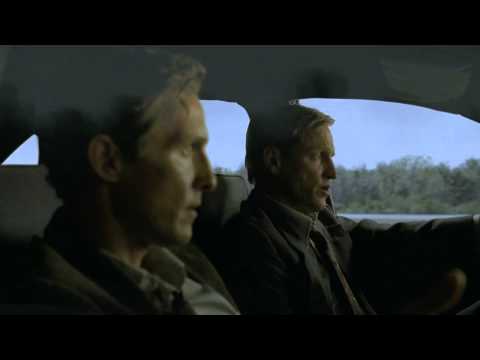
Rust Cohle - Best Philosophical Moments
Matthew McConaughey plays Rust Cohle in True Detective Season 1. The role was part of McConaughey's acclaimed "McConaissance" period, and his performance is widely regarded as one of the finest in television history.
Rust Cohle espouses a form of philosophical pessimism and antinatalism influenced by thinkers like Friedrich Nietzsche, Thomas Ligotti, and Emil Cioran. He describes time as a "flat circle," suggests human consciousness is a tragic evolutionary misstep, and argues that self-awareness is a burden. However, by the finale he finds a glimmer of hope in the darkness.
Cohle's "time is a flat circle" concept draws from Nietzsche's idea of eternal recurrence — the notion that all events in the universe will repeat infinitely. In the show, it reflects Cohle's belief that suffering and evil are inescapable patterns, though it also connects to the show's themes of cyclical violence in Louisiana.
No, Rust Cohle survives the events of Season 1. He is gravely wounded by Errol Childress in the Carcosa lair but recovers in the hospital. The season ends with Cohle experiencing a profound emotional breakthrough and walking into the night with Marty Hart.